
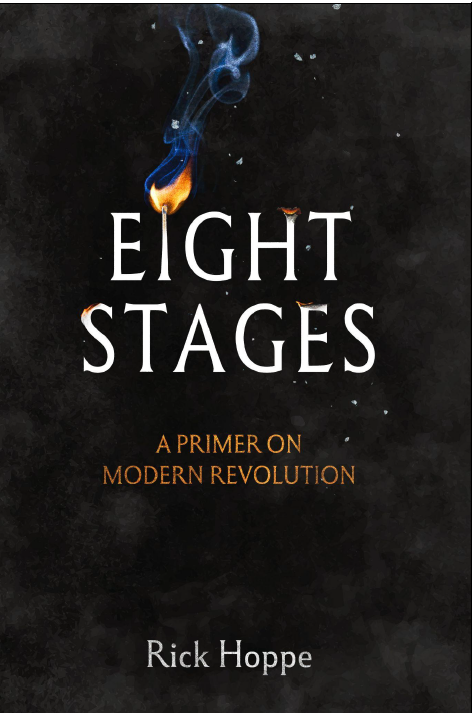
Eight Stages: A Primer on Modern Revolution
About the Book
“Revolutions are not driven by ideas alone, but by the availability of adaptive organizational scaffolding.”
–Rick Hoppe
Eight Stages: A Primer on Modern Revolution presents a structural framework for understanding how revolutionary movements develop, escalate, and consolidate in the modern world.
Rather than treating revolutions as isolated events driven solely by ideology, personalities, or moments of unrest, the book examines revolution as an adaptive process shaped by legitimacy, institutional resilience, organizational capability, social fragmentation, and shifting political conditions.
Drawing on historical case studies, systems analysis, and operational experience in military intelligence environments, Eight Stages explores the recurring patterns that emerge when societies enter periods of sustained instability. The framework focuses not on predicting specific outcomes, but on identifying the conditions and structural dynamics that make systemic disruption increasingly possible.
Written for general readers, analysts, military professionals, educators, preparedness communities, and anyone seeking a clearer understanding of modern instability, Eight Stages emphasizes process over spectacle and structure over ideology.
At its core, the book argues that revolutions are not singular explosions of public anger, but evolving ecosystems of pressure, adaptation, legitimacy, and organizational change.
Key Themes
- Revolutionary dynamics as process rather than event
- Legitimacy and institutional stability
- Conditions vs spectacle
- Organizational adaptation and revolutionary scaffolding
- Polarization and systemic fracture
- Structural analysis over partisan interpretation
- Preparedness through understanding
Available now for Preorder