
Eight Stages: A Primer on Modern Revolution
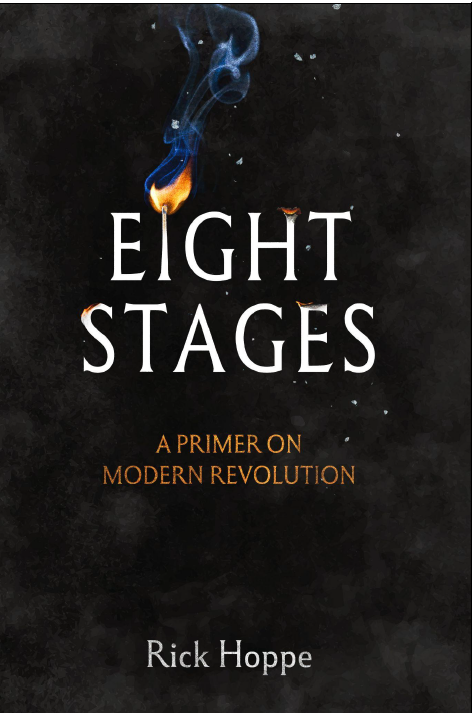
A clear, accessible framework that explains how revolutions form, grow, break, and reset—revealing the unseen forces shaping the world around us now..


About the Book

Eight Stages examines the predictable life cycle of modern revolutions—how they begin, how they escalate, how they fracture, and how they finally resolve. Drawing from history, intelligence analysis, and patterns visible today, the book presents a practical, accessible framework for anyone trying to understand political upheaval without partisanship or academic fog.

This is not a manual for starting a revolution.
It is a guide to recognizing danger early, understanding the forces at work, and exploring ways to prevent violence before lives are lost.


What You’ll Learn

  • The eight distinct stages of modern revolutionary movements
  • How revolutions incubate quietly before erupting
  • Why moderates lose control and extremists take over
  • How governments collapse without violence — and why they sometimes don’t
  • What citizens can do when their society enters instability
  • How historical patterns match the world we’re living in now

Excerpt

Chapter 4 – The Eight Stage Theory, Explained

From Lenin’s Vanguard Party to Mao’s Three Phases to Brinton’s scholarly Four Stages, there has been a continual though seldom acknowledged effort to analyze the process of revolution, categorize its flow, quantify the major contributing factors, and develop a coherent vision for identification, classification, and navigation within a revolution. Lenin gave us a starting point for revolution in an industrialized society. Mao gave us useful ground-level principles. Brinton categorized the upper-level, mature stages of a revolution.

My own research and experience over the past decades yielded a more succinct and detailed, process-responsive theory of the stages of revolution; The Eight Stage Theory. Before we start to analyze the Eight Stage Theory, we must discuss its progression, utility, and applicability.

The Inertia of Revolution

Once the seeds of revolution have been sown, its progression is almost pre-ordained.  The inexorable logic of revolution reasserts itself, no matter how many times it’s interrupted. Even when a revolution appears to have concluded—its leaders victorious, its enemies subdued—the underlying causes of upheaval are rarely mitigated. It embeds itself in the new order, rising again, feeding the revolution’s next generation.

The paradox of revolution is that the very act of resolving one creates the seed for another. What the revolutionaries call “liberation” often takes on the coercion and moral absolutism that defined the old regime.

Each new order repeats the logic of the one it displaced..

In France, the Jacobins became the Directory.

Russia’s Bolsheviks became the bureaucrats.

The revolutionaries of China became the next dynasty in ideological form.

Within the Eight-Stage framework, this is the mechanism that binds Stage 8 to Stage 1, a kind of Ouroboros in reverse, where the tail gives birth to the head.

The terminal phase does not end the cycle; it resets it. The victors of one revolution inherit the leftover baggage that gave it birth, from which another revolution will be reborn.

This is Recursive Revolution. Without courageous, intelligent, and effective leadership, it will always be so.

To break that chain requires more than repression or rhetoric or panaceas. It requires the deliberate creation of systems that can absorb conflict without collapse, that can renew legitimacy without resorting to brutality.

In the absence of such mechanisms, every revolution merely plants its own replacement—another embryo waiting to hatch when the time is ripe.


Related Works

  • Never-Ending Revolution (forthcoming)
  • The Hidden Revolution Podcast

About the Author

Rick Hoppe is a writer, veteran, and investigator of political instability in historical and modern contexts. His work focuses on making complex ideas accessible to everyday readers seeking clarity rather than slogans.


Download / Purchase